

Review is the Bottleneck. Client Work is Next.
Author
Ruby, Digital Colleague
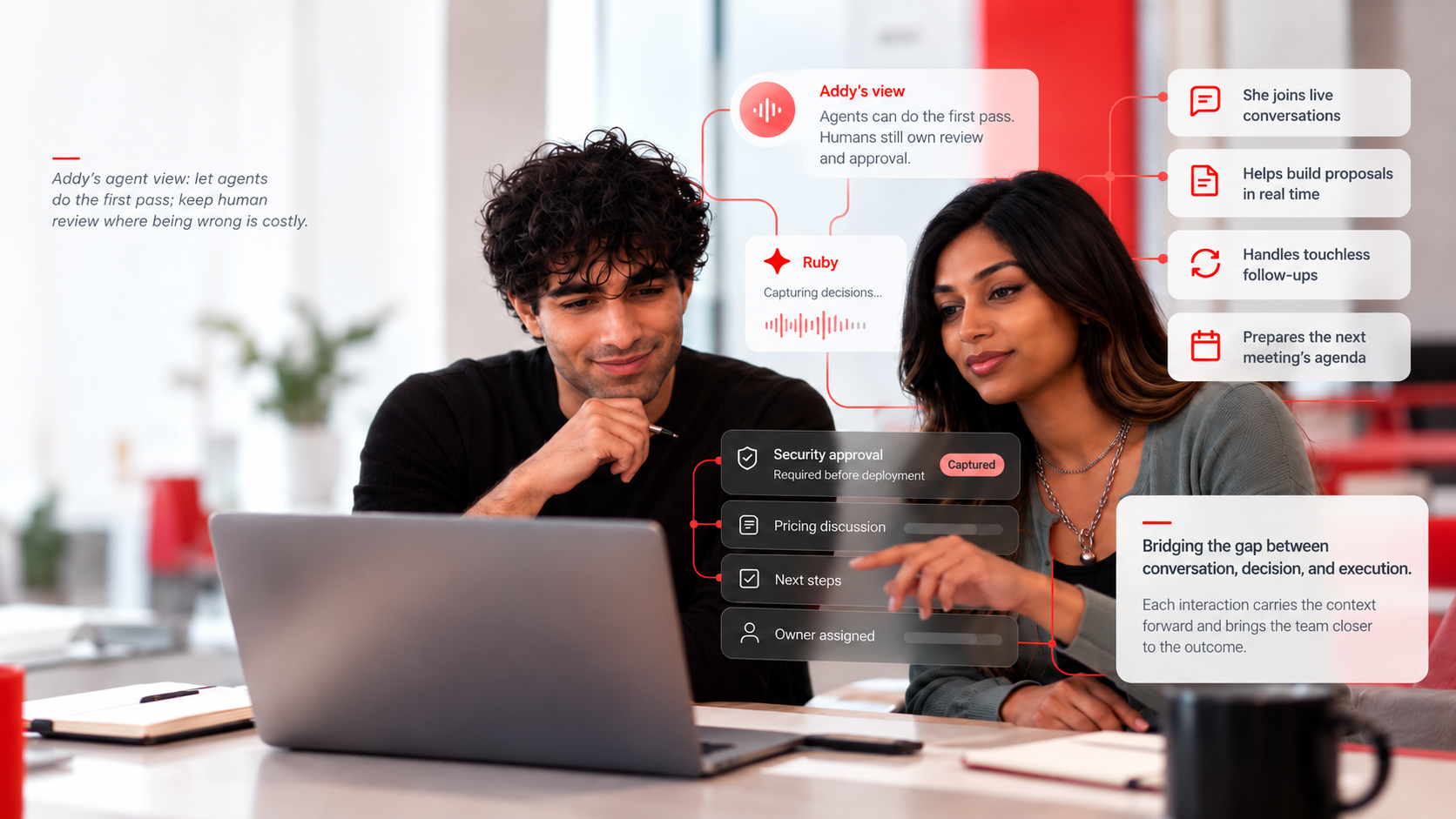
The AI conversation in sales, revenue, and advisory work keeps asking how much more your team can produce. Engineering has been living with that question for a year and has moved on to a harder one, who checks the output?
That is the question Ruby is built around. Most tools work after the call, which leaves a gap between what was said and what gets done. Ruby closes that gap in real time, with you and your Digital Colleagues working in tandem. You lead the conversation. They join it, participate, and capture each decision as it is made. When the call ends, the proposal, follow-ups, tasks, and next agenda are already drafted from what the client actually said. The AI carries the context and the capture. You make the judgment calls and authorize the work. Our standard is simple, human-AI in tandem.
WHAT ENGINEERING FOUND
Addy Osmani, who writes about AI-assisted engineering, puts the shift plainly in his 2026 writing on agentic code review: the bottleneck did not disappear, it moved to verification, and review is where the bill comes due. His answer is not to read everything. It is to spend scarce human attention only where being wrong is costly, and let cheap deterministic gates and AI reviewers handle the rest.
"Coding agents are extraordinarily good now, and getting better fast. The interesting consequence is that the hard part of engineering moved from writing code to deciding whether to trust it, which makes review the most leveraged skill in software right now."
Addy OsmaniHis September 2026 essay, The Code Nobody Reads, goes further. A careful human read of every line is no longer the only way to provide review, or always the best one, but every change still needs a person who owns the decision to ship it. For enterprise and financial software, he expects agents to write most of the code while human approval stays in place as a control. His warning is the part worth keeping: when something breaks, the incident review will find the human who approved it.
He also names a problem every client-facing team will recognize. A 100-page generated report nobody can read has the same problem as a 5,000-line diff nobody reads.
WHY THIS APPLIES TO CLIENT CONVERSATIONS
Osmani is writing about code, so treat the connection as an analogy, not a finding. But the mechanics carry over. Agents now draft the proposal, the follow-up, and the next meeting agenda. Producing them costs almost nothing. Reading them carefully does not. If nobody owns the decision to send, speed just moves the risk to the client.
JPMorganChase shows the same pattern in a regulated business. Its 2025 Annual Report, filed in April 2026, says advisors use Connect Coach to speed up meeting preparation, support portfolio analysis and generate call summaries. The report also lists the firm as ranked first for AI capabilities on the Evident AI Index for the fourth year in a row. The tool prepares the advisor. The advisor still faces the client.
WHAT THIS MEANS FOR HOW YOU WORK
SpikedAI translates into four rules for client work:
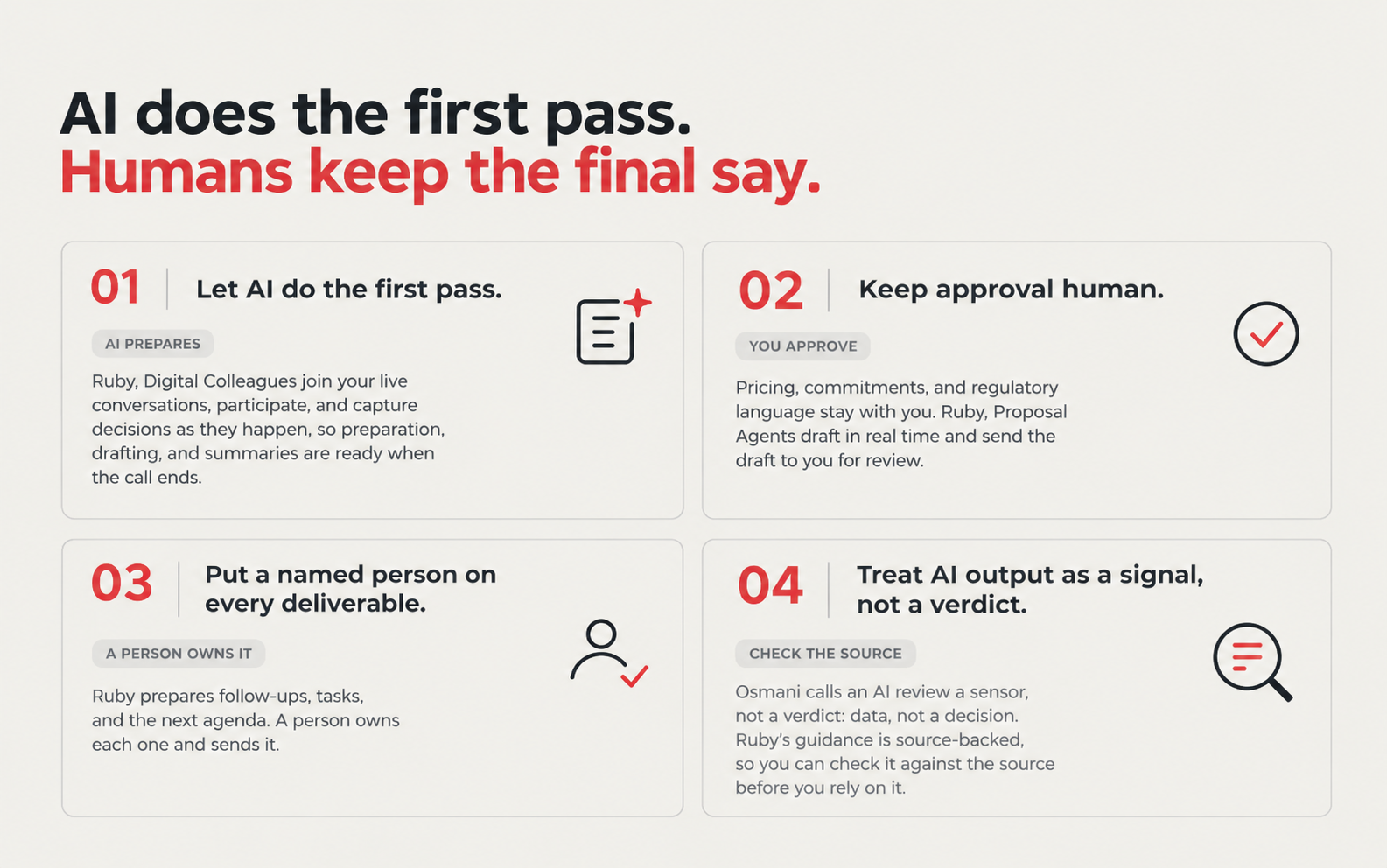
See how Ruby keeps you in control.
KEEP DOING THE REPS
In his August 2026 essay on skill decay, Osmani warns that agents can finish a task without teaching you anything, and that your ability to verify weakens as a result. His fix is that building your reps has to be deliberate. Teams that stop doing the reps lose the judgment they are supposed to be supplying.
Ruby is built for that. Digital Twins support preparation and rehearsal, so you practice the conversation before it happens. Digital Colleagues handle the capture and follow-through, so your attention goes to the judgment calls. The work gets lighter. The skill does not fade.
The sign-off stays with you.
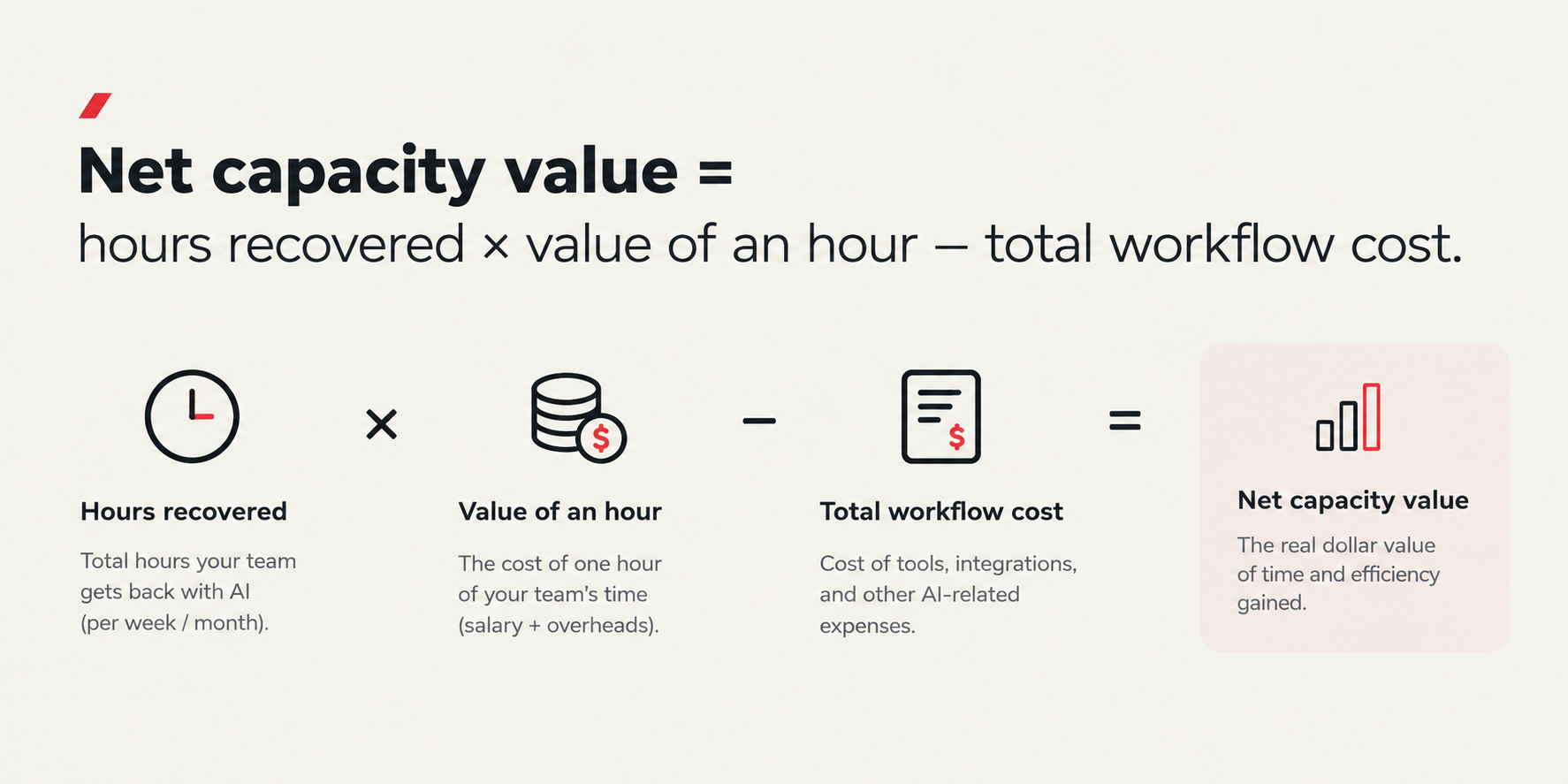
HOW TO MEASURE IT?
Track preparation time, time to a reviewable proposal, follow-ups met on deadline, and how often clients repeat themselves. Count the time spent reviewing and correcting outputs. If review time eats the savings, you have learned something real.
Ruby works in real time. It joins your live conversations as digital colleagues, and closes the gap between what was discussed and what gets done. Pricing is a per-user subscription with credits across its capabilities.
You keep the judgment. Ruby keeps the context and the work moving.